Back in 2024, we wrote a popular post about YouTube’s March 2024 launch of a labeling system for altered or synthetic content. Since then, videos with content fully or partially generated by AI have become increasingly visible on YouTube.
This has created a challenging and uncertain environment for both YouTube audiences and creators.
However, in May 2026, YouTube took action to address the need for an updated labeling system to tackle issues that AI has brought to video production and to provide some guideposts to its different stakeholders.
This step aligns with the EU Artificial Intelligence Act and the key compliance deadline of August 2, 2026.
In this post we will clarify how YouTube’s May 2026 AI labeling update compares with YouTube’s 2024 policies on altered or synthetic content, using YouTube’s own language. We will then share implications of the changes for organizations that produce and publish video content on YouTube.
What changes did YouTube make to AI content labeling (formerly called altered or synthetic content labeling) in May 2026?
Changes in YouTube AI Content Labeling Policies and Practices
Element | March 2024 | May 2026 |
Stated purpose of YouTube AI content labeling | Generative AI is transforming the ways creators express themselves – from storyboarding ideas to experimenting with tools that enhance the creative process. But viewers increasingly want more transparency about whether the content they’re seeing is altered or synthetic. | “Context at a glance” These changes are designed to balance transparency with creator control….In a world where AI is changing what’s possible, our goal is simple: make it as easy as possible for creators and viewers to have the right information. |
YouTube question about AI-generated content | Question: Do any of the following describe your content? Makes a real person appear to something they didn’t say or do Alters footage of a real event or place Generates a realistic-looking scene that didn’t actually occur Yes ◦ No ◦ * You answer this question after your video upload in Video Details. | Question: Was AI used to generate or edit your content in any of the following ways? Makes a real person appear to something they didn’t say or do Alters footage of a real event or place Generates a realistic-looking scene that didn’t actually occur Yes ◦ No ◦ * You answer this question after your video upload in the AI Use field of Video Details. |
Statement on requirement to disclose realistic AI generated content | To follow YouTube’s policy, you’re required to tell us if your content is altered or synthetic and seems real. This includes realistic sounds or visuals made with AI or other tools. Selecting yes adds a label to your content. | To follow YouTube’s policy, you’re required to tell us about your use of AI. This includes realistic sounds or visuals made or edited with AI. View examples Selecting “yes” adds a disclosure to your content. |
Examples requiring disclosure of AI generated content |
|
|
Examples not requiring disclosure of AI generated content |
| Not realistic
Minor
|
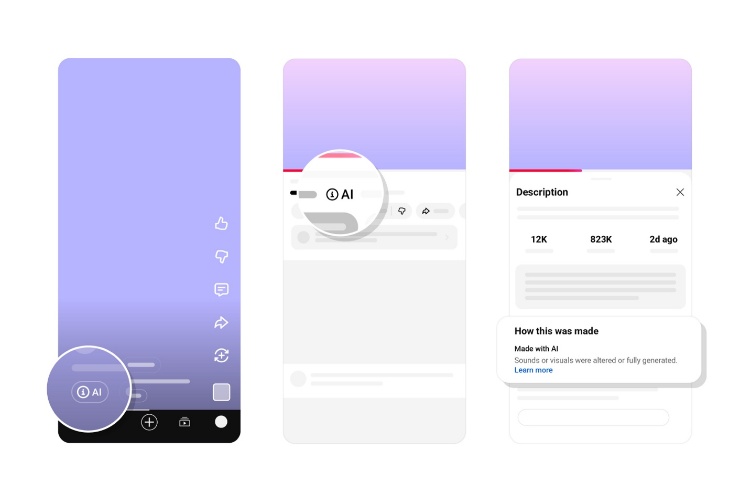
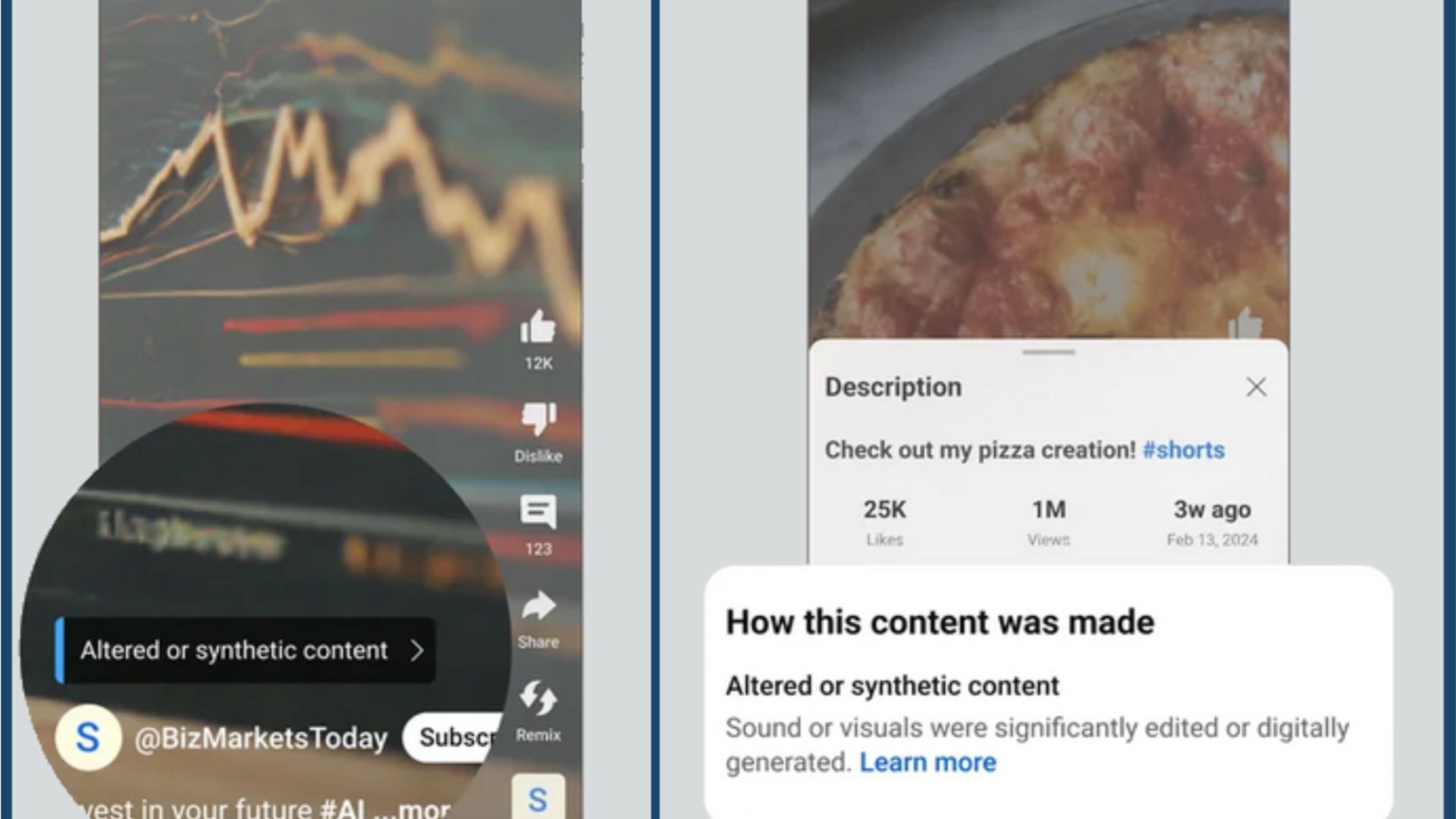
Location where YouTube AI content label will appear | For most videos, a label will appear in the expanded description, but for videos that touch on more sensitive topics — like health, news, elections, or finance — we’ll also show a more prominent label on the video itself. | We’re moving the disclosure label for photorealistic and meaningfully AI altered or generated content to a more prominent position. For Long-form Videos: The label will now appear directly below the video player, above the description. For Shorts: The label will appear as an overlay on the video itself. By moving these labels on to the main stage, viewers get the context they need at a glance. This is now the single label format for all photorealistic and meaningfully AI altered or generated content on YouTube. For content that is unrealistic, animated, or slightly altered, viewers can find this disclosure in the expanded description. *This latter disclosure seems to represent a lower “tier” and needs to be manually completed by the creator in the Description area. YouTube provides little guidance for standards or formats for this disclosure. |
What will the labels say? | YOUTUBE SHORTS Altered or synthetic content with a clickthrough to How this content was made Altered or synthetic content Sounds or visuals were significantly edited or digitally generated Learn more HORIZONTAL VIDEO Original YouTube 2024 post did not address horizontal videos. | YOUTUBE SHORTS
with a clickthrough to How this was made Made with AI Sounds or visuals were altered or fully generated Learn more HORIZONTAL VIDEO
with a clickthrough to How this was made Made with AI Sounds or visuals were altered or fully generated Learn more |
Collaboration with external partners on standard-setting | Importantly, we continue to collaborate across the industry to help increase transparency around digital content. This includes our work as a steering committee member of the Coalition for Content Provenance and Authenticity (C2PA). | No visible statement regarding external collaboration on standards accompanied the announcement of the new labeling changes. |
Enforcement of YouTube AI content disclosure and use of automated AI detection | In the future we’ll look at enforcement measures for creators who consistently choose not to disclose this information. In some cases, YouTube may add a label even when a creator hasn't disclosed it, especially if the altered or synthetic content has the potential to confuse or mislead people. | While we still require creators to manually disclose when they use realistic AI, we want to make the process more seamless and reliable. Starting in May 2026, we’re rolling out new internal signals to help identify AI-generated content. If a creator doesn’t specify whether or not they used AI, but our systems detect significant photorealistic AI use, we will now automatically apply a label. As this technology continues to improve, creators remain in control. If a creator thinks their content was incorrectly identified as AI-generated, they can update the disclosure status in YouTube Studio. However, disclosures will remain permanent in a handful of cases, including: Content created using YouTube’s own AI tools, like Veo or Dream Screen. Content containing C2PA metadata indicating they were fully generative AI. Creators who consistently choose not to disclose this information may be subject to manual application of a label, or penalties from YouTube, including removal of content or suspension from the YouTube Partner Program. |
Requests to remove AI-generated content | …we’re continuing to work towards an updated privacy process for people to request the removal of AI-generated or other synthetic or altered content that simulates an identifiable individual, including their face or voice. We’ll have more to share soon on how we’ll be introducing the process globally. | No visible statement about removal requests in announcement of YouTube new AI content labeling policies. |
Analysis of where YouTube is headed in AI content labeling
We can see that YouTube has moved in numerous new directions in the area of AI-generated content labeling since 2024. Here’s an analysis of YouTube’s new (2026) AI content labeling:
- Language about AI-generated content. YouTube now uses language that specifies the role of AI in generating or acting on content. Previous language refers to content as “altered or synthetic.” YouTube’s new language about AI-generated content aligns better with that of the EU Artificial Intelligence Act.
- More prominent labeling of AI content. YouTube is making it easier for viewers to determine if something is generated by AI – with, for example, “context at a glance,” more prominent AI-generated content labels.

- Steps towards a more automated AI detection and labeling process. YouTube is working towards automation of the labeling process through detection of and labeling actions based on C2PA metadata (and/or Google SynthID watermarks). This methodology still has a way to go to facilitate labeling of all relevant AI-generated content, while not resulting in errors; thus, at present, creators continue to be required to manually disclose if they have used AI-generated content in their YouTube videos.
- Promoting YouTube’s own AI content generation tools. YouTube is developing and promoting YouTube’s own AI image, video generation, and editing products, such as Veo and Dream Screen that will work more seamlessly with its system for AI-generated content.
- Keeping its definition of AI-generated content and what requires disclosing a bit vague. According to YouTube: “AI content can include content that is fully or partially altered or created using any AI audio, video, image creation or editing tools. Realistic AI content and meaningful changes require disclosure, while non-realistic or minor edits don’t.”
- Prioritizing disclosure of deceptive imagery and audio. YouTube continues to prioritize disclosure of visual (“photorealistic”) and audio AI alterations that imitate reality and could trick people by resembling real people, places, events, sounds, etc. YouTube has highlighted the areas of news, medicine, finance, and politics as ones where care must be taken and where disclosure and labeling is of high importance to avoid causing serious disruption and harm. While disclosure is still required, YouTube is not as focused on animated or unrealistic AI-generated content.
- Not requiring disclosure for AI voice narration or voiceovers when paired with original content. Use of AI voices is increasing on YouTube. YouTube is not, however, requiring disclosure when they are used for basic narration or text-to-speech voiceovers when paired with original content. However, disclosure of other uses is required.
- Requiring disclosure of AI-generated music. YouTube requires disclosure of AI-generated music (in the Video Description).
- Declaring that creative AI-use will not impact video search and discovery or monetization. In this labeling update, YouTube conveys a clear message to creators that, though disclosure may be required, YouTube will not penalize them in search and discovery or monetization when using AI-generated content in creative, original ways. This issue had been the source of a good deal of discussion and complaint among creators. Clearly, YouTube wants to unleash the creative possibilities of AI on its platform; however, it does still need to balance this with policing photorealistic and other techniques that could deceive viewers.
Next step: Determine your video production workflow involving AI
Which AI-generated production elements might be included in a video production workflow?
The following are some key video production elements where AI can play a role in the video production process:
- AI Video Scripting
- AI Creation of New Graphics, Photos, and Footage
- AI Editing of Existing Graphics, Photos, and Footage
- AI Voiceovers
- AI Music and Sound Effects
- AI Video Generation
- AI Captioning, Translation and Dubbing
Your team will need to consider how you want AI use to be used, handled, or not used at all for each of these production elements. This is critical for organizational and brand integrity, as well as for setting up the necessary YouTube disclosure processes.
As you engage in this thinking process, we noticed that HookLab in the U.K. has published a helpful reference with questions to ask yourself about AI in your workflow(s), as well as common mistakes to avoid.
Because obtaining agreement and compliance from staff and/or outside partners will be critical, a good way to clarify and document video workflow decisions pertaining to AI is in an AI Policy. In this, your organization’s values, the efficiency and effectiveness of different tools, the YouTube AI labeling requirements, and other factors all come into play.
Should YouTube AI disclosure requirements affect decisions about using AI for video?
There are at least two reasons YouTube’s AI disclosure requirements might influence your decisions about using AI for specific production elements:
- You may not want an AI label on your videos, as it may not fit with your mission or brand; and
- When you use AI for any of the production elements, it will take staffing time and care to determine the needs for disclosure for each video and to carefully complete the appropriate disclosure(s) when uploading YouTube.
It’s true that your organization could consider using AI, but not disclosing AI uses. However, YouTube states that, “Creators who consistently choose not to disclose this information may be subject to manual application of a label, or penalties from YouTube, including removal of content or suspension from the YouTube Partner Program.” This could be a major problem for you and your organization, and increasingly risky as YouTube moves further towards automated detection methods.
Tips for managing and documenting your AI disclosure process
In the blog post “YouTube AI Policy for Suno Music Creators: What You Need to Know in 2026,” Gary Whittaker offers several excellent tips for for YouTube disclosure in the area of AI music that apply equally to most of the other AI production elements you might be using:
- "Do not assume YouTube will only know what you tell it.
- Keep your own production notes for every serious release.
- Use consistent disclosure language in descriptions when it helps viewers.
- Avoid using AI-generated realism in ways that confuse the viewer.
- Check YouTube Studio carefully before publishing, especially the AI use setting under video attributes."
These are good tips to abide by, but do require attention and care during production, especially if you are using AI in multiple ways.
YouTube disclosure requirements for video production elements
1. YouTube disclosure requirement for AI scripting in video production
Scripting with AI does not require disclosure on YouTube.
However, because YouTube’s search and discovery system promotes content based on viewer signals—what they search for, watch, skip, choose to interact with and react to— making sure your video scripts are engaging and original remains important.
2. YouTube disclosure requirement for AI generation of new graphics, photos, and footage
Generating graphics, photos, or footage with AI does require disclosure on YouTube.
Methods of disclosure vary, however, based largely on two categories into which YouTube divides AI-generated content.
Two categories of YouTube AI-generated content
YouTube’s primary categories of AI-generated content are:
1) Photorealistic; and
2) Unrealistic, animated, or slightly altered using AI.
Photorealistic AI-generated content
For production involving AI generation of new graphics, photos or footage, YouTube’s highest concern is with the generation of AI content that is photorealistic. YouTube has stated that photorealistic AI is concerning in areas such as news, medicine, finance and politics, as those are areas where such content can cause harm.
YouTube thus requires creators to disclose use of photorealistic AI in the AI Use section of Video Details—a disclosure that now leads to a prominently placed, autogenerated label indicating that all or part of the video’s content is AI-generated. YouTube also seems most focused on enforcement against your video or channel if you use photorealistic AI without disclosure.
Production Note: It seems like the creator should also disclose the tools used and purpose of using them in the expanded description for this category, as is required for the unrealistic, animated or slightly altered using AI category (see just below), but YouTube does not say this explicitly.
Unrealistic, animated, or slightly altered AI-generated content
For the category of content that is unrealistic, animated, or slightly altered using AI, YouTube does not require that creators include disclosure in the AI use section of video details. Instead, YouTube requires that creators disclose AI use in this category solely via the expanded video description, a less prominent placement.
You or a colleague will need to write this latter disclosure yourself, and it is expected that you name the specific software (e.g., Runway ML, Veo, etc.) and state how it was used in the production process (e.g., "Runway ML was used to generate the scene of cars stopping at a stop sign." or "VEO was used to create the animated movie marquee with our organization’s name.")
YouTube’s automated AI detection and labeling
There is yet a third type of AI disclosure that bears mentioning, particularly in this section on AI visuals, which is such a prominent and growing area of AI use in video. This is YouTube’s new automated detection and labeling.
Your team likely already has access to tools for using AI in graphics, photos and footage creation (as well as other areas) by virtue of pre-existing subscriptions or access to platforms such as those from Adobe, Google, Eleven Labs, and even YouTube itself. And you are probably aware that, in addition to traditional uses for manual graphic design, animation, video recording and editing, the same platforms now provide the option to generate images, video footage, graphics, voiceovers, and even edit using AI.
Using these tools can be tempting. And, in fact, your use of them on these platforms has some interesting connections to YouTube’s AI labeling efforts, as well as potentially to enhanced transparency around AI use. Specifically, many platforms and tools such as these can produce outputs with C2PA metadata or Google SynthID watermarks, thus making their use of AI- or human-generated content (possibly) visible to YouTube, as well as other platforms and stakeholders.
We say “possibly” because C2PA metadata and Google SynthID watermarks can be stripped deliberately and are often stripped by social media platforms and editing software. Thus, there is no guarantee that your use of AI will be well documented in your video end product. The retention of metadata and watermarks is, however, bound to improve in the future—and probably is the future for documenting the provenance (i.e. origin) of both human- and AI-produced content.
3. YouTube disclosure requirement for AI editing of existing graphics, photos, and footage
Editing of existing visual production elements with AI may require disclosure on YouTube.
AI is now used in many tools used for editing of existing graphics, photos and footage. Within Final Cut Pro video editing software, for example, AI is built into tools that help with converting horizontal videos to vertical, color correction, rotoscoping (background removal), motion tracking, voice isolation, creating closed captions and smooth slow motion. Such tools are available not only in major editing software but in large numbers of apps as well.
The majority of uses of these types of AI tools to modify existing assets do not require disclosure on YouTube—that is, unless they lead to videos that fall into the photorealistic category.
For example, take the use of AI tools for background removal, or rotoscoping. In general, their use does not require disclosure on YouTube. In fact, YouTube lists “green screen used to depict someone floating in space” as an AI use that does not require disclosure. From this formulation, we can infer (and others online have) that using AI tools that remove backgrounds from images or video and place a person in a clearly unrealistic or even neutral background would be permitted.
However, if background removal tools are used for photorealistic AI, such as if a person is cut from a background placed in a new background, implying that they were in a certain place that they were not, this would require disclosure. An example would be using background removal to place your organization’s CEO at a conference or international disaster when s/he was not there.
In general, YouTube seems to not require disclosure of AI use where tools perform similar functions to those which were done more manually and through mathematical algorithms in traditional editing software, and/or which are similar to using editing filters.
Another example of this is upscaling editing tools such as those from Topaz Labs. While using an upscaling tool to bring clarity to an image or footage does involve AI generating new pixels, YouTube’s thinking seems to be that upscaling is more akin to a “traditional” edit like a sharpening filter.
4. YouTube disclosure requirement for AI for voiceovers for video
AI voices when used for narration or as voiceovers paired with original content do not require disclosure on YouTube.
However, if a voice is created and used that realistically imitates someone else and could cause deception (such as a cloned voice), this does require disclosure on YouTube. An example would be using cloning to create a voice resembling someone famous to serve as the voiceover for your organization’s fundraising video.
You can, however, clone your own voice. And you can use text-to-speech functionality for narrating a script or accompanying original content, without disclosure.
YouTube claims that it can differentiate between AI voices used for original content versus repeated uses of AI voices by video content farms.
5. YouTube disclosure requirement for AI music or sound effects for video
AI music and sound effects do require disclosure on YouTube. This disclosure would generally be in the expanded video description. However, if the music or sound effects fall into the “realistic” category that could deceive audiences that something actually happened that didn’t (for example a realistic sounding explosion in a realistic city scene), use needs to be disclosed in the AI use field of the Video Details.
As with photo, graphics and footage generation, disclosures in the expanded description area of the video should include the tool used to create the particular music or sound effect and the level of human direction. For example, you may need to write something like: “Suno AI was used to create the background music with human selections, editing, and direction.” Because, like AI generated graphics and footage, AI-generated music files may include C2PA metadata and/or Google SynthID watermarks, YouTube may be able to identify AI-generated music. Thus, you will need to be sure to disclose the use of AI music and sound affects, or risk penalty.
Reduced-AI Production Note: Music and sound effects is an area where it would not be too hard to avoid using AI. There are plenty of stock music pieces and sound effects available commercially for a small licensing fee as well as for free through online video creation and social media platforms. Much music and sound creation software also does not depend on AI.
6. YouTube disclosure requirement for using AI for video generation
Use of AI for video generation, in other words, using AI to edit a video, such as having AI create a video based on a script you input or create a video from a few clips you upload, does need to be disclosed as a use of AI on YouTube.
Popular apps or software that allow you to generate videos include Descript, Runway ML, Kling.ai, Canva, Powtoon, as well as Adobe Firefly, Davinci.ai and more. You can create cinematic video from text, images or video. It is honestly incredible what you can do these days, and this kind of video generation has found its way into major studio use, as well, with higher price, high-quality video generation models. Using AI in this production element is highly energy-intensive and potentially expensive if using high quality models, and definitely will require disclosure. While manual disclosure by you is currently required, this type of video editing is rapidly becoming more seamless and tied in with C2PA and video watermarking, which is easier for YouTube to detect automatically.
Depending on your organization's budget and policies around energy use, this could be a production element in which to avoid using AI in your workflow.
7. YouTube disclosure requirement for using AI for captioning, translation, and dubbing for video
Captioning, translation and dubbing using AI do not require disclosure on YouTube.
YouTube enables creators to upload their own caption files, which these days are often generated via third-party apps that make use of AI. And creators can also edit YouTube's AI-generated autocaptions to produce final captions for their videos.
Furthermore, YouTube now offers a full, largely automated, AI-based production process that includes not only captions, but also translation into multiple languages and even audio dubbing in a growing list of languages.
YouTube announced important AI-related enhancements to its autodubbing on its official blog in February 2026, and continues to refine the features, which include improvements to better handle expressive language and some capabilities to fine-tune timing issues in dubbing due to inherent differences in the structures of the languages.
As YouTube rightly knows as it seeks ever more viewership and traffic, its largely automated sequence of YouTube captioning, translation and dubbing permits creators to reach wider audiences around the globe--and do so with minimal production effort. Creators no longer have to produce and upload individual videos, caption files, or soundtracks in each of the languages in which they want to produce, as YouTube's AI can do it for them.
And at the same time, audiences worldwide can access more and more videos in languages outside their native and other preferred languages, as can be seen in the video below by Jeremy Chapman, which also describes how these dubbed videos are produced and managed.
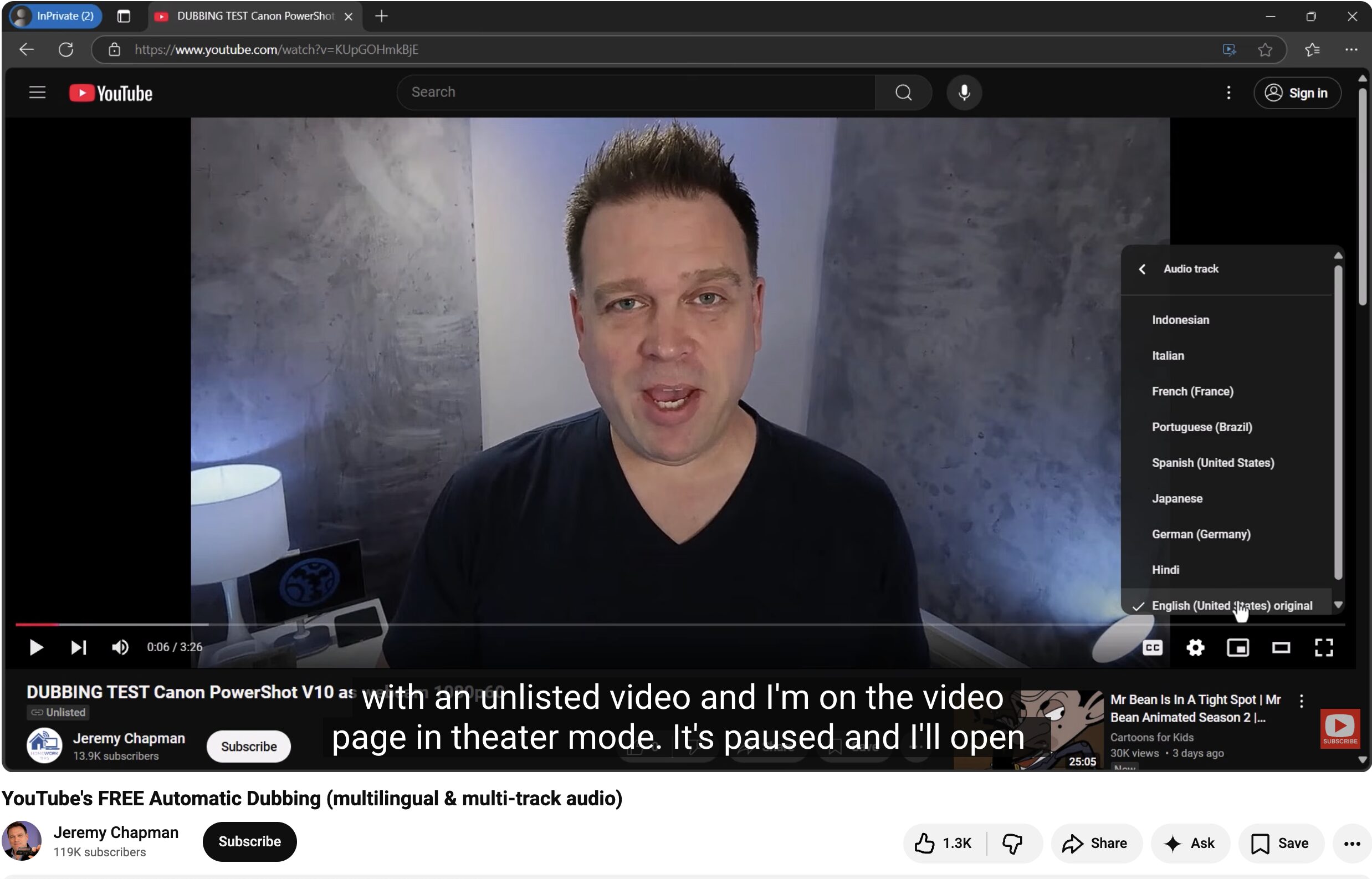
YouTube Viewer Experience of Autodubbing (Source: Jeremy Chapman)
Although YouTube doesn't specifically address AI disclosure and labeling issues related to the translation and dubbing anywhere we looked, we can infer that there is no disclosure requirement for AI captioning, translation and dubbing, as YouTube provides all of these features on its platform with no visible labeling to be seen on videos that use these features. Perhaps this may change if the linguistic dubbing becomes highly realistic, but for now there seems to be no disclosure requirement.
Production Notes: Some of these features--particularly the translation and autodubbing--are only available to creators who have been granted early access to these features or who apply successfully to YouTube for access to these advanced features. However, AI-generated captioning is likely a feature familiar to most creators, and a likely part of your workflow.
We always advise quality checking captions in their original languages, especially proper names, terms unique to your organization and acronyms, as well as checking translations and dubs, if you are using them, to the extent possible.
Summary of what you need to disclose about AI on YouTube
We have summarized YouTube disclosure requirements for the different production elements in a handy table.
YouTube Disclosure Requirements for the Different Production Elements
Production Element | Requires YouTube Disclosure? | Where to Disclose? |
AI Scripting | No | N/A |
AI Creation of New Graphics, Photos, and Footage | Yes | Photorealistic – AI Use field of Video Details* Unrealistic, animated, or slightly altered content – Expanded description |
AI Editing of Human-Generated Graphics, Photos, and Footage | Yes, if photorealistic, implying something is said or happens that did not happen No, otherwise. | Photorealistic – AI Use field of Video Details* |
AI Voiceovers | Yes, if used to imply that a person has said something they have not (e.g. a cloned voice of a known person), or if used alongside AI-generated repetitive content. No, if narration or voiceover is used with original content, or if a clone of your own voice. | Cloned/realistically implying a person has said something they have not content - AI Use field of Video Details* |
AI Music | Yes | AI Use field of Video Details* |
AI Sound Effects | Yes, if realistic and implying something happened that did not happen No, otherwise. | AI Use field of Video Details* |
AI Video Generation | Yes | Photorealistic - AI Use field of Video Details* Unrealistic, animated, or slightly altered content – Expanded description |
AI Captioning, Translation, and Dubbing | No | N/A |
*While not specifically mentioned in the YouTube blog or help documents at present, these uses seem like they should also be disclosed in the Expanded Description in a similar manner to the unrealistic, animated or slightly altered content uses. (In other words, with the AI tool used and the purpose for which the tool was used.)
With this summary, we close this post. Here are links to YouTube’s May 2026 AI labeling update and the key informational documents for YouTube’s 2024 Altered and Synthetic Content Labeling Policies.
Current YouTube help articles that are useful references are:
Several points were out of the scope of this post that we may address at a later time. These include:
- What are AI disclosure requirements for video platforms besides YouTube?
- What does a good video section of an AI policy look like?
- What are examples of how associations and nonprofits are using AI in video production?
This post was complicated to research and write and we welcome comments to improve it or correct any inadvertent inaccuracies. Feel free to reach out to us at videos@minimatters.com.
Add your text here.